


We start with your decision and conclude the one value it requires.
A loan, an audit, an acquisition and a dispute each call for a different value. We fix the one your decision requires before work begins, and we study the entire enterprise around it so nothing is counted twice or left out.

Your decision sets the scope.
The use and the reader come first.
We confirm how the value will be used and who will rely on it. A credit officer, an auditor and a court each read a report differently.
The definition and the date follow.
Market value, fair value and fair market value answer different questions. We state which one applies and the date it is measured.
The terms are set in writing.
Scope, fee and delivery date are confirmed in writing before work begins, and the delivery date runs from engagement.
We understand the whole enterprise before we value the part you need.
Real Property
The land and buildings, and the share of the operation’s income they earn.
Equipment
The furniture, fixtures and machinery the operation runs on.
Intangible Assets
The licenses, brands, contracts and customer relationships that turn a property into a business.
Debt
The loans against the enterprise. Subtracting them turns enterprise value into equity value.
Working Capital
The cash, receivables and inventory needed to keep operating. Some definitions of value include it and others leave it out.
Ownership Interests
Each owner’s share of the equity, and the control and marketability that share carries.
A tested engine computes, and an appraiser concludes.
Our rule for technology is fixed. Calculation belongs to software that has been tested, and judgment belongs to the appraiser, who selects the evidence, weighs it and signs the conclusion. Each report states its conclusion first, and the appraiser who signed it answers the questions that follow.
Valor is the platform we are building on that rule. It will hold every component of an enterprise in one model, so each value we conclude reconciles with the others.
When several parties rely on the value, each conclusion reconciles with the others.
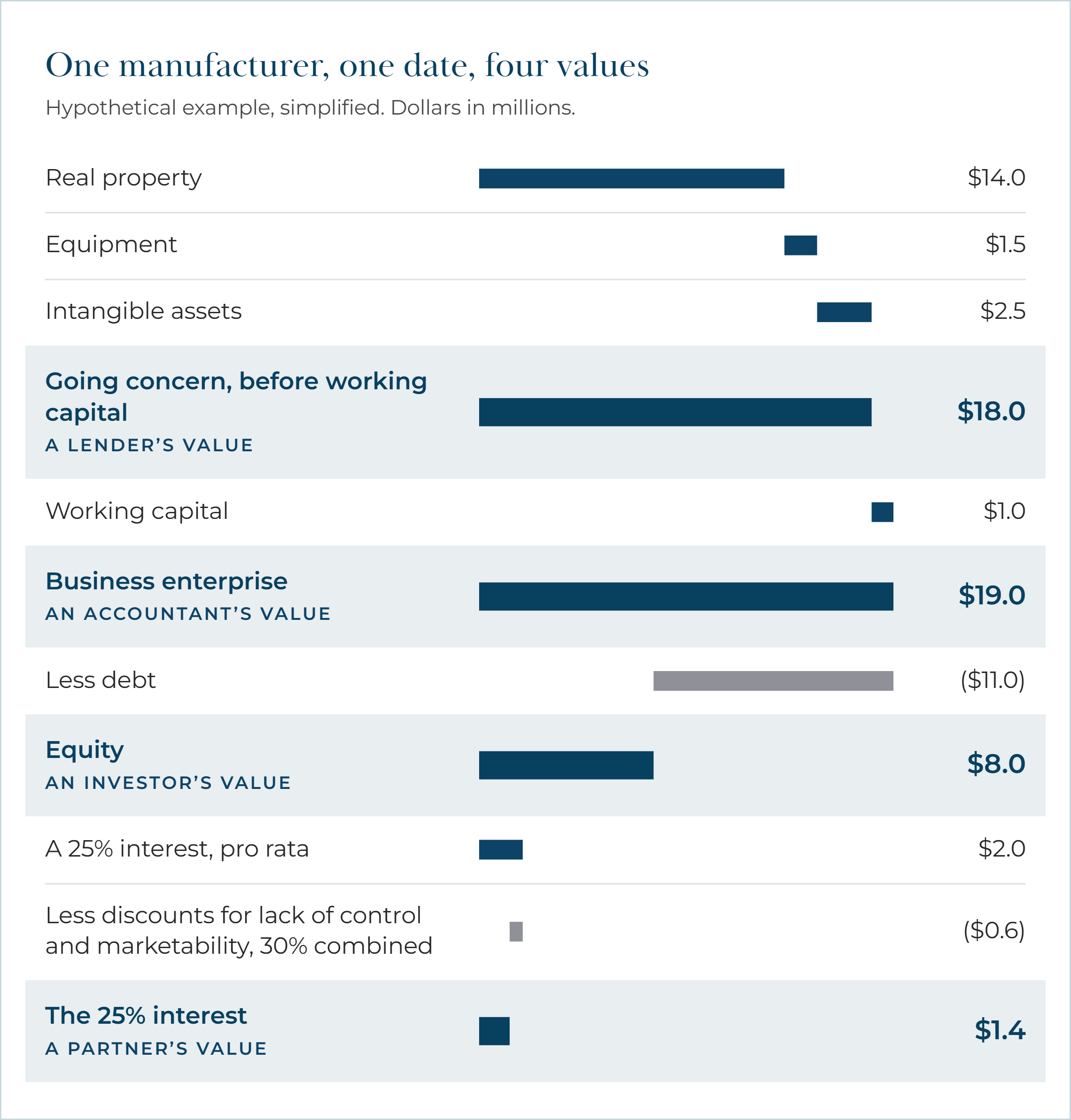
Take a hypothetical manufacturer on one date. Its real property, equipment and intangible assets total $18.0 million, the going-concern value a lender relies on. Adding $1.0 million of working capital gives the $19.0 million business enterprise an accountant measures.
Subtracting $11.0 million of debt leaves $8.0 million of equity for an investor. A partner’s 25% interest is $2.0 million pro rata and $1.4 million after a 30% combined discount for lack of control and marketability. Each value is correct for its reader, and all four come from one model. We prepare this reconciliation when an assignment calls for it.

Tell us the decision in front of you, and we will tell you which value it requires.
DC Metro: 1640 Boro Place, 4th Floor, McLean, VA 22102
Northeast Florida: 425 Town Plaza Ave, Ponte Vedra, FL 32081
Northeast Ohio: 1409 W. 10th Street, Cleveland, OH 44113